Most visitors never learn that Santorini is one of the oldest continuously planted vineyards on earth. The vines grow on their own roots in volcanic ash, which is why the phylloxera plague that wiped out Europe's vineyards never took hold here, and some root systems are centuries old. All of this sits in the quiet southern half of the island, twenty minutes from the caldera crowds. Your host picks you up in Fira and drives you out in their own car, not a coach, on a half day built entirely around wine.
The first thing to understand is the kouloura. Santorini has no rain in summer and a wind that never stops, so growers weave each vine into a low basket shape, with the grapes ripening inside the coil, protected from wind and sand. Your host pulls over at a vineyard near Megalochori so you can crouch next to one and see how it works before you taste what it produces.
The main tasting is at Gavalas Winery in Megalochori, a family cellar that has made wine for five generations. You will taste four wines poured by the people who make them, typically a crisp assyrtiko, the sun ripened nykteri style, and the amber sweet vinsanto that ages for years in old casks. Then you drive up to a second, different kind of cellar for a shorter flight, which one is your host's call on the day, perhaps Venetsanos, the gravity built 1947 winery hanging above Athinios port, or the Hatzidakis cellar near Pyrgos.
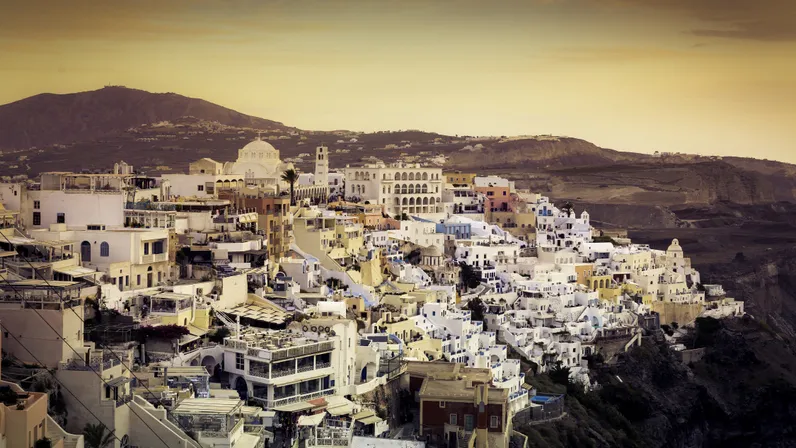
In between you stroll Pyrgos Kallistis, the island's highest village and its former capital. Its whitewashed lanes spiral up to the ruined Kasteli castle quarter, and from the top you see the whole island laid out, the caldera on one side and the vineyards running to the sea on the other. There is time for a coffee in the square before your host drives you back to Fira.
Two honest notes. Wineries here are working farms, on Sundays and during the harvest some cellars close, so your host may swap in a similar one. Guests under the legal drinking age are welcome to join but will not be served alcohol at the tastings.