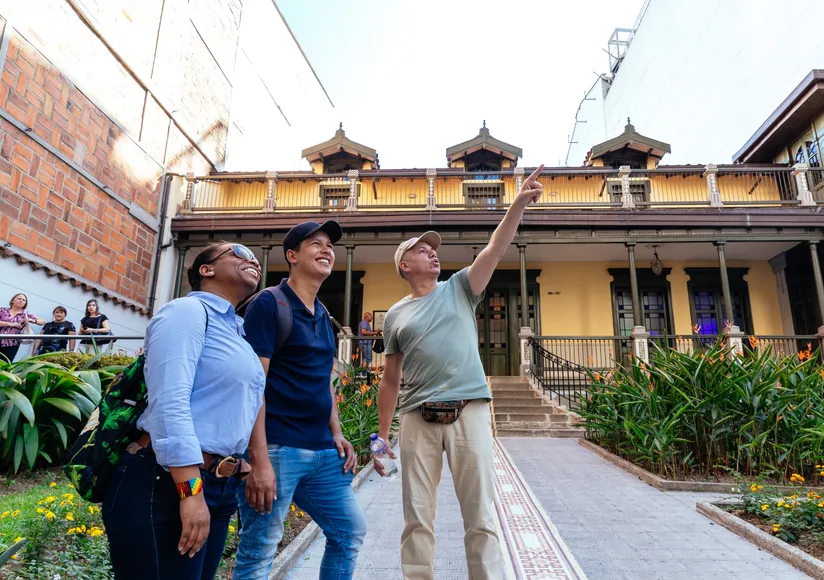
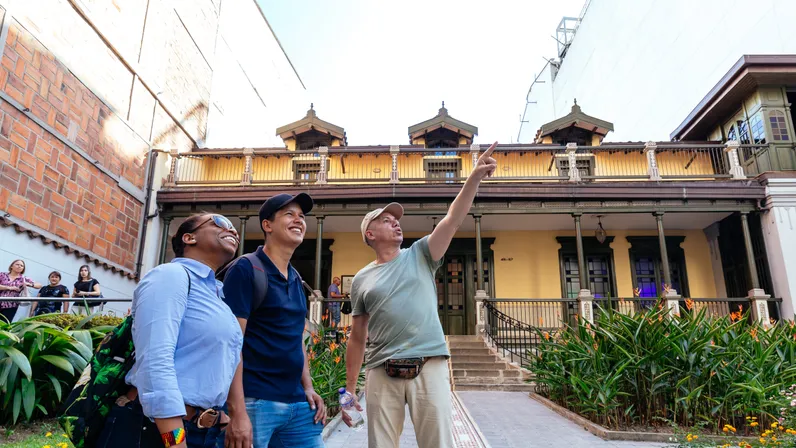
Before Medellin was anything, Santa Fe de Antioquia was the capital. It was founded in 1541 in the hot valley of the Cauca River and ran the province until 1826. Then the capital moved to Medellin and the town stopped growing, which is why it still looks the way it did: white houses, heavy wooden doors, flowering balconies and cobbled streets around a big square. For people in Medellin it is where you go for a hot weekend. For you it is a day in colonial Colombia with a local.
You meet your host at the Terminal del Norte and take the regular bus west. The road climbs out of the valley and runs through one of the longest road tunnels in Latin America, then drops into warm, dry country. Your host tells you how Antioquia was settled, gold, mules and all, and why Paisas still go on about their independence.
In town you walk the Plaza Mayor, the cathedral and the quieter church squares, with your host pointing out the old mansions and the craft of the carved doors and window grilles. On the square you stop for a tamarind sweet and a fresh juice, both included. Santa Fe is known across Colombia for its tamarind, and the sweets are sold from the same stalls as a century ago.
Then a tuk tuk takes you out to the Puente de Occidente, a suspension bridge over the Cauca finished in 1895. When it opened it was one of the longest of its kind in the Americas, and it was designed by Jose Maria Villa, an engineer from Antioquia trained in the United States. You walk across the wooden deck, over one of Colombia's great rivers, before heading back to town and the bus to Medellin.
A practical note. Santa Fe is much hotter than Medellin, often above 30 degrees, so bring a hat, sun cream and water. Lunch is not included, but your host knows the good places on the square. The bridge is sometimes closed for repairs, and then your host shows it from the riverbank.